

Industrial Mechanic (Millwright)
433A - IMATC2

Program Highlights

- State-of-the-art facilities
- “Earn while you learn” training model, combining on-the-job and in-school training
- In-school training lead by faculty and staff who are experienced, licensed journeypersons
- You may qualify for income support while in school through Employment Insurance Canada benefits or training allowance
What you'll learn
- Get exposed to all aspects of the manufacturing, production and maintenance needs of industry.
- Learn and master the changes and techniques required by industry in maintaining and repairing factory equipment and automated systems.
- Develop skills in the theory and practice of machine fabrication and repair operations.
- Principles of measurement, metallurgy, automated systems, mathematics, blueprint interpretation, safety and troubleshooting.
Program format
- Thinking about an apprenticeship program? Learn how it works.

Course Overview & Descriptions
Click on the course title for a course description.
Learning Outcomes
Program Learning Outcomes for apprenticeship programs, are defined within the Curriculum Training Standard for each trade, and set out the essential learning that a student must achieve before being deemed ready to graduate.
View the training standard for this trade
The Curriculum Standards are developed by Skilled Trades Ontario in consultation with representatives from the trade and Training Delivery Agent instructors.
Admission
Offers of classroom training are issued by the Ministry of Labour, Immigration, Training & Skills Development and registered with Skilled Trades Ontario.
Please ensure your school preferences are up to date with Skilled Trades Ontario via their portal.
Learn more about Apprenticeship.
Tuition and Fees
To complete your registration and secure your seat, please follow the link provided in the in-class training offer email from the Ministry. Registration and payment must be completed online.
Phone calls cannot be used to reserve a seat. If you experience any issues with the registration link, please contact us by email at apprenticeship [at] mohawkcollege.ca (apprenticeship[at]mohawkcollege[dot]ca)
Personal Protective Equipment (PPE) Requirements
You will also be required to purchase safety equipment, tools/supplies and/or exam fees. PPE required for the first day of classes includes CSA approved safety glasses and safety boots or shoes. Full details will be provided in your classes or at your orientation. This is an additional cost (above tuition/ancillary fees and textbooks).
Financial Assistance
When it comes to paying for your education, investing in your future can be more affordable than you think. A Mohawk education is one of the most cost-effective means of acquiring the skills and knowledge you need to have a prosperous and rewarding career.
As you start on your chosen career path, it's important to have a realistic set of expectations regarding the expenses associated with attending college. In addition to your tuition fees, you will also need to budget for books, supplies, housing, and other related living expenses. You may be able to supplement your income and savings with scholarships, bursaries, or loans. It pays to do some research into what types of financial assistance you may qualify for.
Available Financial Assistance Resources:
- Additional Sources of Funding
- Financial Assistance Home Page
- Government of Ontario financial supports for apprentices
Apply for Awards:
By submitting a Scholarships and Bursaries Application every semester, students have access to over $3 million in Mohawk College scholarships, bursaries and Ministry-partnered funding to help meet their financial needs.
Financial Literacy:
Whether saving for school, sticking to a budget, or planning for a major purchase, financial literacy affects us all. That's why Mohawk College is dedicated to helping students improve their financial literacy and become more confident in managing their money.
- Complete the free online Money Matters Module to earn Co-Curricular Credit!
- Financial Resources and Calculators
Experiential Learning
How you’ll gain skills
This apprenticeship consists of 8,000 hours:
- 7,280 hours of on-the-job work experience with your employer
- 720 hours of in-school training at Mohawk College
- View the Skilled Trades Ontario for this trade.
Labs and Simulation Spaces
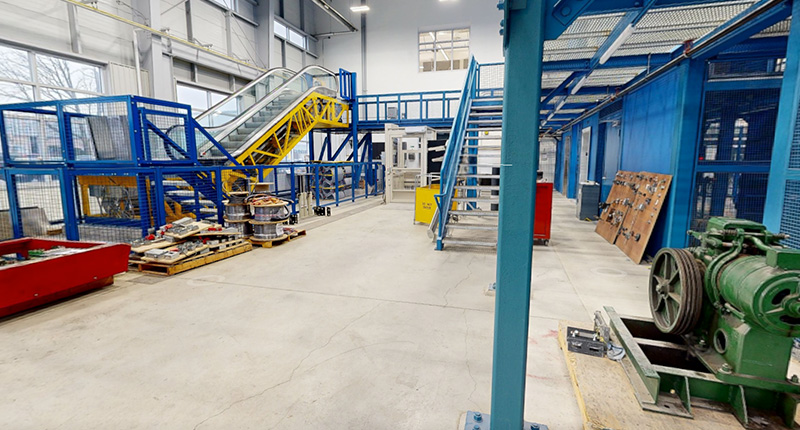
Elevating Device Lab
The Elevating Device Lab is equipped with a range of equipment commonly used by elevator mechanics in the field. In this lab, students engage in practical tasks that closely resemble those they will perform on job sites. This lab includes a traction elevator, a hydraulic elevator, two shafts for constructing various elevator components, a lift for individuals with disabilities, an escalator and various controllers designed to enhance troubleshooting skills.
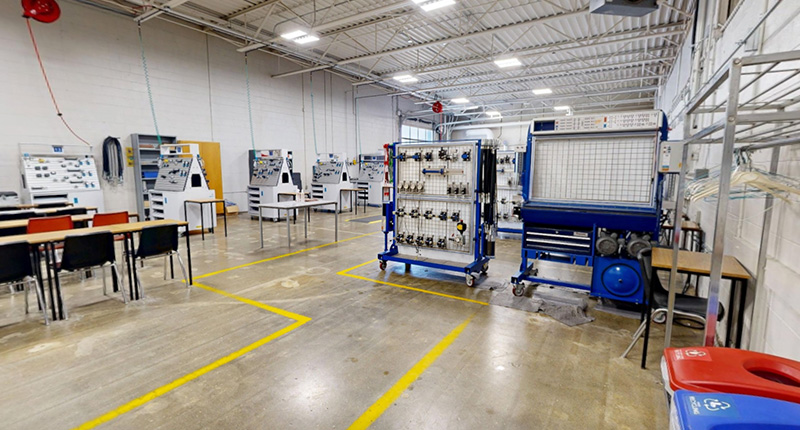
Hydraulics Lab
This lab introduces the principles of industrial hydraulics, including the design and application of power units, pumps, motors, conductors and fluids. Utilizing fluid power equipment, our students have the opportunity to do lab experiments with typical valving and accessories found in industry today. With a variety of applications, hydraulic systems are used in all kinds of large and small industrial settings, as well as buildings, construction equipment, and vehicles.
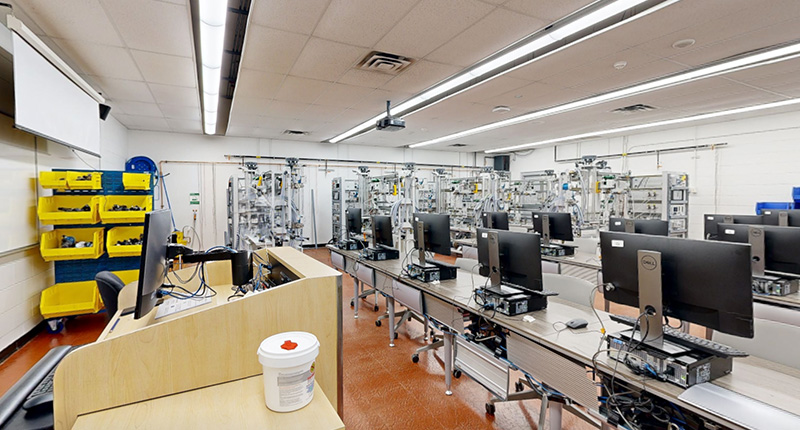
Instrumentation & Control Lab
In the Instrumentation and Control Lab students are taught how to install, maintain, calibrate, design and troubleshoot networking systems, process control equipment and environmental protection systems for a wide range of industrial applications.
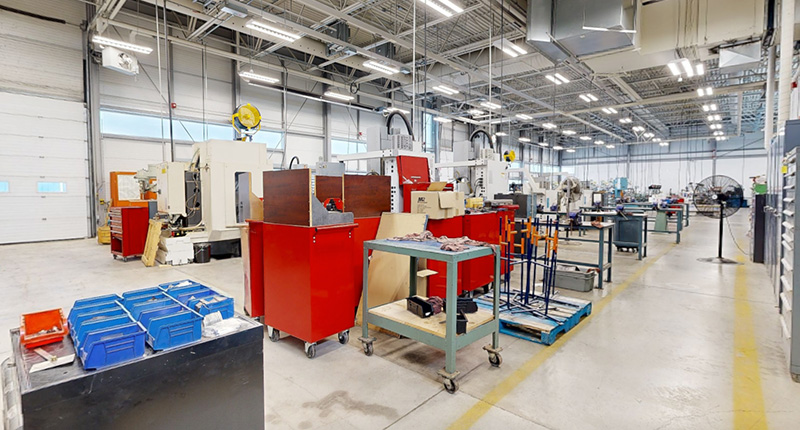
Machine Shop
General Machinists cut, shape and finish metal to produce precision machined parts and components used in all areas of manufacturing. Our students interpret engineering drawings (blueprints) and work process documents to set up machine lathes and mills to create precision machined parts and components. This process is carried out in tandem with measuring or inspecting work-in-progress using specialized precision tools and equipment

Pneumatics Lab
Pneumatics and programmable logic controllers (PLCs) form a core function of the automated process within manufacturing. Students learn the application of relay logic and basic PLC programming, utilizing handheld units on multi-cylinder trainers, simulating a typical industrial application to automate a production process. They learn how to develop basic pneumatic schematics using standard ISO symbols, and assemble and troubleshoot the circuits using the schematics.
Educational Pathways
Pathways to Mohawk College
If you've successfully taken a course at another post-secondary institution, you may be able to earn course exemptions toward your credential here at Mohawk College. In addition, prior learning you have achieved through work or other life experiences, outside of formal educational courses, may count towards your program through Prior Learning Assessment & Recognition (PLAR).
If you have successfully completed one of the following programs at Mohawk College, you may be eligible to receive transfer credit in this program. To start a new program at Mohawk College, you must apply via ontariocolleges.ca.
Receiving Program
Industrial Mechanic (Millwright)
Transfer to
You can transfer from the Industrial Mechanic (Millwright) to the following programs:
Bachelor of Business Administration (Trades Management) (Honours) (Pathway Business - Trades)
Mohawk College makes every effort to ensure the accuracy of each transfer opportunity. Please note that changes may occur in program offerings, admission requirements, and transfer credits granted by the receiving institutions. We advise all students to check with the receiving institution directly for the most up-to-date information.
Don’t see what you’re looking for? Search ONTransfer.ca for more pathways with Ontario public colleges and universities.
Mohawk College makes no warranty or endorsement of material contained within links to external websites, nor does the College assume any responsibility for the linked website or its contents.
Career Opportunities
Your future career options:
- Industrial Mechanics
- Mechanical Engineering Technologists and Technicians
Where you could work includes:
- Transportation Equipment Manufacturing
- Fabricated Metal Product Manufacturing
- Primary Metals
- Food Industry
- Automated Manufacturing
- Power Generation
- Automotive Industry
- Mining
- Pulp and Paper
Opportunities for grads:
- Certificate of Qualification (C of Q)
Meet our faculty


We're here for you to support applications and admissions by providing online and virtual services.
General Inquiries
Please call (905) 575-1212.
Applied and have questions?
Email Admissions or Book an appointment in person or by phone.
Haven't applied and need help?
Email Recruitment or Book an appointment in person or by phone.
Applied as an international student?
Take a Virtual Campus Tour
Explore Mohawk College from the comfort of home! Our virtual campus tours provide a guided visit of our buildings, labs, services, classrooms and athletic and recreation centre.
Program Delivery
Learn about program delivery terms.
Please note: in-person, virtual, and hybrid classes vary according to the program and some programs may be in-person only. Refer to the Program Overview for more information.
Personalize your Mohawk experience
Explore programs, select your interest and create your custom viewbook. Get the information you want. Instant, online and delivered to your inbox.

Ready to become an apprentice?
There are four ways of entering a skilled trade in Ontario, find out what option works best for you.

Contact us
Apprenticeship Engagement Specialist
Amy Petsche
amy.petsche@mohawkcollege.ca
