


Hamilton-based Carbon Cap Inc. has designed a Flue Gas Recirculation system (FGR) that recovers waste heat and re-introduces it to reduce energy use. Carbon Cap partnered with Mohawk College's Energy & Power Innovation Centre (EPIC) to support the automation of the FGR system prototype and test its performance.

Research Area: Energy and Power Innovation Centre, IDEAWORKS
Funder: Ontario Centre of Innovation, BLOOM Centre for Sustainability
Research Team: Zahraa Mazin-I-Khalil, Rubaid Khan, Mariano Arriaga, Jaydeep Prajapati (student), Kevin Wazny (student), Bassam Assaf (student)
Future Ready Challenge
The world is turning green. Canada’s appetite for clean products and technologies is growing fast, and investments are following, such as the federal government’s commitment to doubling investments in eco-innovation and clean energy R & D in order to achieve a 30% reduction in 2005 Greenhouse Gas emissions (GHGs) levels by 2030. This encourages innovators to reimagine everyday energy challenges, such as finding more efficient at-home energy solutions.
In the Greater Toronto and Hamilton Area (GTHA), buildings are the largest source of GHGs, producing 43% of total emissions. Almost 95% of building GHGs come from the natural gas used for space and water heating. Part of the problem is that many apartment buildings use older boiler systems for heating, which are 20–40% less efficient than their newer counterparts.
R & D Collaboration
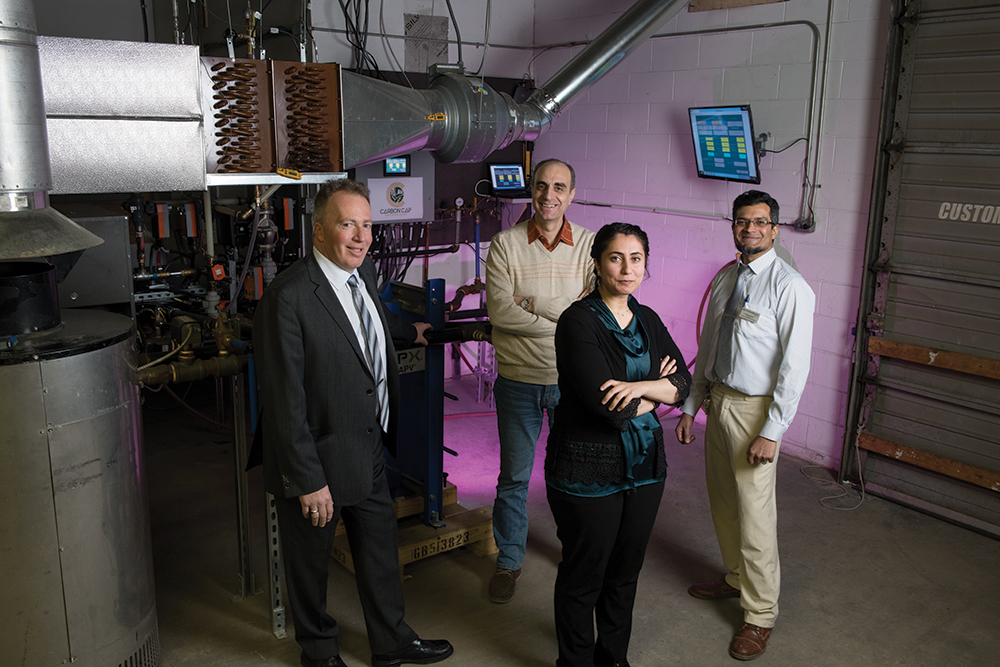
Hamilton-based Carbon Cap Inc. has designed a Flue Gas Recirculation system (FGR) with a proprietary economizer that increases heating efficiency in buildings by using the heat from exhaust flue gas in legacy boilers. Instead of exhausting the hot (180°C) waste boiler gas into the atmosphere, the FGR mechanically diverts it into a pair of runaround coil loop heat exchangers to absorb the residual heat energy. The heat exchangers are used to recirculate the heat into the building’s space and water heating loop, reducing the building’s natural gas consumption for these two services.
Carbon Cap built a manually operated FGR prototype but needed to automate its operation and control system, create an interface for remote monitoring, and test the system’s performance. Carbon Cap asked the Energy and Power Innovation Centre (EPIC) to support their work on these challenges for their FGR prototype.
Innovative Results
To automate the control and operation of the prototype, the research team selected and supported the programming of a Programmable Logic Controller (PLC), and installed automatic valves and variable speed pumps to control the water flow in the system loops. The team then installed temperature sensors to provide feedback to the control loop and designed a Human-Machine Interface (HMI), a data logging system, and remote monitoring capabilities. These improvements provide flexibility to interact with the system and analyze its performance.
With the newly semi-automated prototype installed in a boiler room, the team tested pump speeds and operating modes to improve energy recovery, and calculated GHG reductions and cost savings, and estimated that the prototype automated system can potentially reduce natural gas consumption by 13%. For a residential building that spends $35,000 on natural gas annually, this means potential savings in the range of $4,500 to $5,000, and reducing GHG emissions by the equivalent of nine cars’ annual emissions.
With Mohawk's ongoing support, Carbon Cap has received funding from Sustainable Development Technology Canada to pursue further research on the technology as it prepares the system for deployment to housing complexes in the GTHA. technology as it prepares the system for deployment to housing complexes in the GTHA. Carbon Cap is working with Hamilton Housing to explore the FGR’s application, ideally in an apartment building with 50 or more units to maximize impact. The company is also a finalist for the Natural Gas Innovation Fund (NGIF) competition that would net a $300,000 grant. Carbon Cap’s industry partnerships have added great value to the project’s outcomes: Hydronic Parts Group, o'Shanter Developments, mcCallumSather, AVL Manufacturing, Madok Manufacturing, Mount Hope HVAC, Belimo Canada, Grundfos Canada, Horner Automation, EA Group and the IRC Center Mississauga.
Raphael Kolenko, Managing Director of Operations for Carbon Cap, says “EPIC’s resources, combined with our ongoing collaborative work, will ultimately see the FGR system fully demonstrated in live buildings and help us realize the vision of our system.”
