

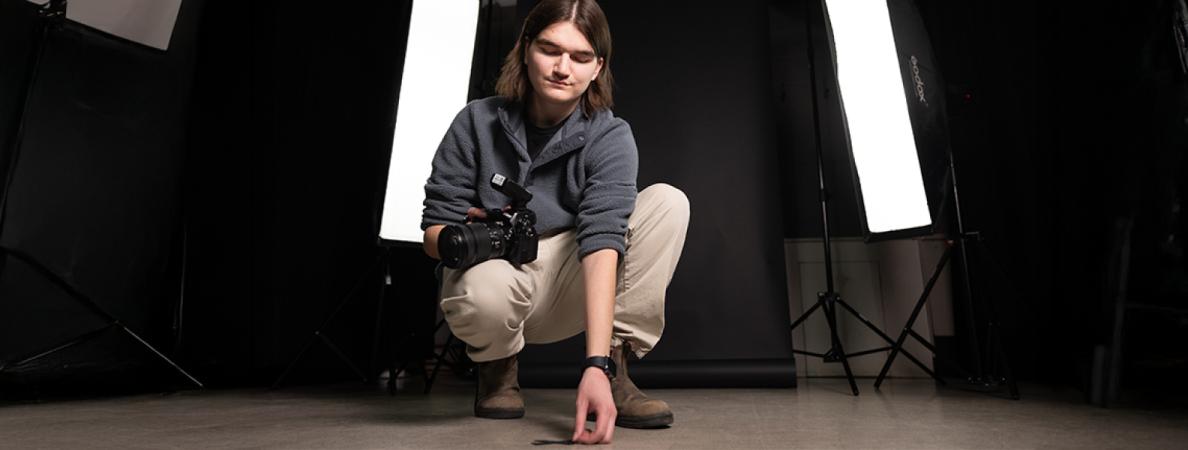
Logan was just 13 when he got an opportunity he couldn’t pass up. His dad, a longtime Brantford Bulldogs photographer, handed him a camera and invited him to capture a game. Logan didn’t just take some photos; he ran with the opportunity.
More than 150 professional games later, including the Toronto Maple Leafs and Hamilton Tiger-Cats, his work has received over one million views on Instagram in 2025 alone. But starting young came with a challenge: being taken seriously. It’s something Logan learned to navigate early, proving himself one game at a time.
Now at Mohawk College, he’s taking his experience further. In the Photography – Still and Motion program, Logan is mastering broader aspects of a photography career, combining real-world experience with an enterprising approach to build his own professional path.
“I feel like anyone can take a picture, but it takes more of a professional to create an impactful image,” says Logan. “That is what this program has done for me and how it’s turned me from a kid with a camera to a professional. I now know how to leave someone with that wow factor.”
Expanding his craft
Through Mohawk College’s industry-led training, Logan is stepping outside his comfort zone and building a more well-rounded skill set to keep pace with a changing industry. Alongside shooting various types of photos, he’s learning how to work in a studio, set up lighting and think more intentionally about composition.
“A big part of our program is thinking critically about our photos,” he says. “We have critiques, and it makes me look a little deeper into each photo and put more thought into the images that I’m taking.”
The lessons extend beyond technical skills. Logan is also learning how to think like a professional photographer, from presenting his work effectively to navigating the business side of a creative career. In courses like Photography of Business and Self Promo & Portfolio Design, he’s gained skills in pricing, branding and building a professional portfolio.
For someone aiming to work full-time in a major sports league, the broader training has been a key part of his experience
“They teach you video, stills and business all in two years,” Logan says. “So, I get this all wrapped up in a nice little two-year bundle rather than going to school for four years just for photography and not learning the video or business aspects.”
Industry-led learning in focus
Having navigated professional photography from a young age, Logan understands how essential hands-on opportunities and industry access can be. It’s something he appreciates about how Mohawk College opens doors to real-world experiences for students.
One example is the college’s new partnership with the recently renovated TD Coliseum. Through the connection, students from various programs can be paired with arena staff across departments, gaining a behind-the-scenes look at day-to-day operations and how a large venue runs.
“TD Coliseum was where I shot my first game,” says Logan. “I think that a lot of people just need a foot in the door, and something like that also looks really good on a resume, that you’ve worked down at a big venue. It’s really, really important that the college can give people an opportunity like that.”
The type of exposure that happens in professional settings is something Logan also still values. Shadowing his dad left a lasting impression. Even now, he observes others in the field, whether he’s watching the Blue Jays as a fan or working alongside photographers at a Maple Leafs game.
“I think the best way to learn is to be in it and do it,” he says. “And if you’re trying to get to where that person is in the industry, watching them do what they do and how they handle certain situations is extremely valuable.”
Logan’s approach of learning by doing, observing and adapting has shaped how he builds his career. It’s also helped him look past the sports-focused lens he brought to Mohawk College, exploring new areas of photography.
“For someone who’s potentially debating going into Still and Motion, keep an open mind,” he says. “When I first started the program, I was like, ‘I shoot sports, and that’s it.’ But now I do portraits, products and food, and all this stuff. Keeping an open mind really helped me through the program.”