

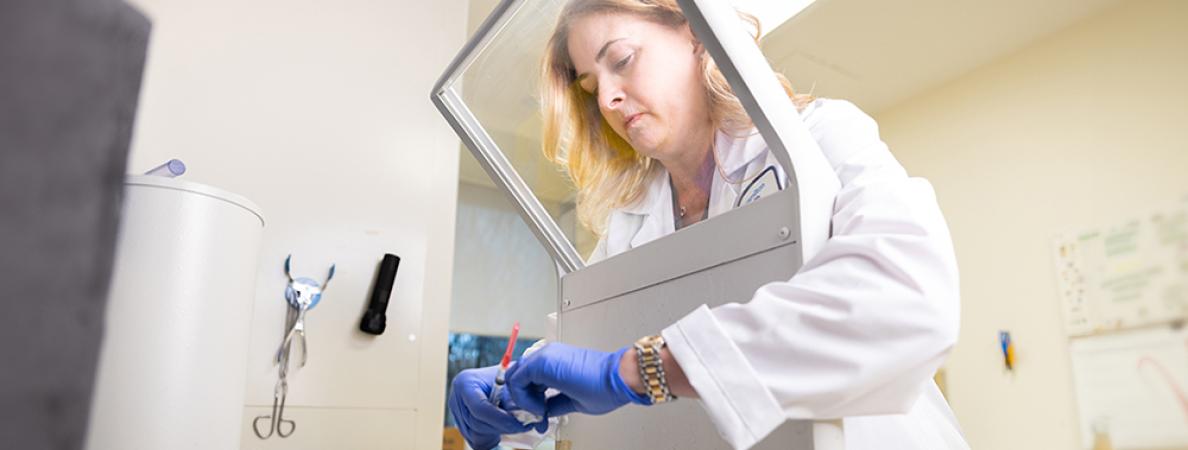
The field of nuclear medicine has experienced significant growth in recent years, and is increasingly integrated into healthcare facilities and patient treatment plans. This career offers meaningful work that’s in high demand and generally offers a great work-life balance.
Let’s dive into how to become a nuclear medicine technologist, what a nuclear medicine technologist is, what they do and the education and skills required to become one.
What is a nuclear medicine technologist?
Nuclear medicine technologists are healthcare specialists who carry out nuclear medicine imaging and therapeutic procedures. They work as part of a team of healthcare specialists, playing a key role in the use of nuclear medicine.
“The technologists, or nuclear medicine technologists, are our first-line heroes,” says Dr. Olfat Kamel Hasan, nuclear medicine physician at Hamilton Health Sciences and assistant professor at McMaster University.
Who do nuclear medicine technologists work with?
In addition to nuclear medicine technologists, members of a nuclear medicine department can include:
- Nuclear medicine physicians
- Oncologists
- Radiochemists
- Nurses
“Nuclear medicine departments are never just a single person, there’s always a large team,” says Chantal Saab, a nuclear medicine technologist with Hamilton Health Sciences.
The role of a nuclear medicine technologist
The main duty of a nuclear medicine technologist is to carry out various nuclear medicine imaging procedures. They are responsible for preparing the patient, administering the radiopharmaceuticals and operating the equipment used to capture a variety of functional images. Those images will then be interpreted by a nuclear medicine physician.
If a patient is undergoing a therapeutic procedure known as theranostics, the nuclear medicine technologist will administer the required radiopharmaceuticals and monitor the patient during the course of treatment.
In addition to carrying out and assisting in the use of nuclear medicine, an important aspect of a nuclear medicine technologist’s job is interacting with patients.
“As a [nuclear medicine] technologist, we’re typically the first group of people that patients will see when they begin their ‘diagnostic journey’,” Chantal comments.
Part of that interaction is making sure the patient is as comfortable as possible before, during and after their procedure. This can be accomplished by educating patients about the procedure, asking them questions or simply being a listening ear.
“I take the time to explain our procedure to make them feel comfortable with what’s happening, answer whatever questions they have, just to give them a sense of control over what’s about to happen to them,” Chantal explains.
The ins and outs of being a nuclear medicine technologist
Typical workday
A nuclear medicine technologist's workday typically follows a predictable structure but can also include new experiences and opportunities.
“My day-to-day usually starts around 7 am to 8:30 am, depending on my rotation,” says Azia, a nuclear medicine technologist. “What’s nice is that when you come to the department, you get a general overview of the scheduling, what types of tests you might do for each patient, as well as their appointment times. So, you can kind of plan out what your day looks like and how to organize your time to match the overall workflow of the department.”
During the workday, a nuclear medicine technologist could complete various kinds of procedures depending on where they work.
“There are probably 50 different procedures that can happen in the nuclear medicine department, and that’s a minimum,” Chantal comments.
With new procedures and varieties of radiopharmaceuticals constantly being developed, there will always be new things to learn and master.
“I’ve been doing this for 30 years and, honestly, every day is different still,” Chantal says.
Work-life balance
Many jobs in the healthcare industry are very demanding, with hectic work schedules and long hours. Nuclear medicine technologists, however, can expect to have a good work-life balance with a consistent schedule.
“Our hours of operation are typically Monday through Friday, sometimes Saturdays,” Chantal says.
Nuclear medicine technologists primarily work weekday hours and typically avoid the late shifts common in many other medical professions. Most nuclear medicine facilities close in the late afternoon to early evening, typically between 3 and 6 pm.
Is it dangerous?
The word “nuclear” often invokes images of people in hazmat suits and dangerous technologies that belong in science fiction movies. In reality, working in nuclear medicine is not like that at all.
“The doses [of radiation] that we work with in nuclear medicine are quite low and it’s quite safe,” Chantal explains.
Even though nuclear medicine technologists only work with very low doses of radiation, there are still strict safety procedures and protocols in place to keep technologists, patients and other members of the nuclear medicine department safe. Nuclear medicine technologists wear PPE (personal protective equipment) such as lab coats and gloves, and use technologies like auto-injectors to keep radiation exposure to a minimum.
“We also wear dosimeter badges to monitor how much radioactivity we’re exposed to,” Chantal says. “Those are monitored every quarter to make sure that we stay within the [radiation exposure] limits. These are very low limits. I personally have never reached my quarterly limit at any time in career.”
Nuclear medicine technologist wages and employment outlook
According to the Government of Canada’s Job Bank, the median wage for a Nuclear Medicine Technologist in Ontario is $44 per hour, but wages can vary from $32.50 to just over $ 50.00 per hour.
The employment outlook for this field is considered good in Ontario. New jobs are being created to address the growing need for nuclear medicine technologists. Additionally, many current nuclear medicine technologists are retiring, leaving previously existing roles vacant.
“The demand is rising, and this is not only in Ontario, it is all over Canada nationwide” Dr. Hasan states.
Skills and education required
Nuclear medicine technologists are required to complete a two-three-year nuclear medicine technology college program. Afterward, they must complete a certification exam from the Canadian Association of Medical Radiation Technologists (CAMRT) and register with governing bodies, such as the College of Medical Radiation and Imaging Technologists in Ontario (CMRITO), before they can begin practicing.
Mohawk College’s Nuclear Medicine and Molecular Imaging Technology Advanced Diploma program
Nuclear medicine has seen a steady increase in use as new treatment methods, radiopharmaceuticals and technologies are being developed.
Mohawk College is helping to fill the growing gap in nuclear medicine through the Nuclear Medicine and Molecular Imaging Technology Advanced Diploma program. During the six-semester program, students will receive high-quality instruction and hands-on training from experienced nuclear medicine technologists and other nuclear medicine experts.
A highlight of the Nuclear Medicine and Molecular Imaging Technology Advanced Diploma program is its use of online learning to provide students with more freedom and flexibility in pursuing their careers as nuclear medicine technologists. The first two semesters of the program are comprised of almost entirely online learning. The following semesters are a combination of online learning, in-person skills labs and clinical placements.
Through this combination of flexible online learning and experiential learning in both the classroom and workplace, Mohawk College helps nuclear medicine technology students become career-ready professionals who excel in the workplace.
“What strikes me is that they [Mohawk College graduates] are very well prepared,” Dr. Hassen comments. “They have good hands-on experience before even coming [to the workplace] because their program is actually integrating the science and knowledge with the practical skills.”
Mohawk College is helping to shape the future of nuclear medicine by preparing students for their fulfilling future careers as nuclear medicine technologists. Learn more about the Nuclear Medicine and Molecular Imaging Technology Advanced Diploma program and how you can start your career in nuclear medicine by visiting the Nuclear Medicine and Molecular Imaging Technology Advanced Diploma program page.