

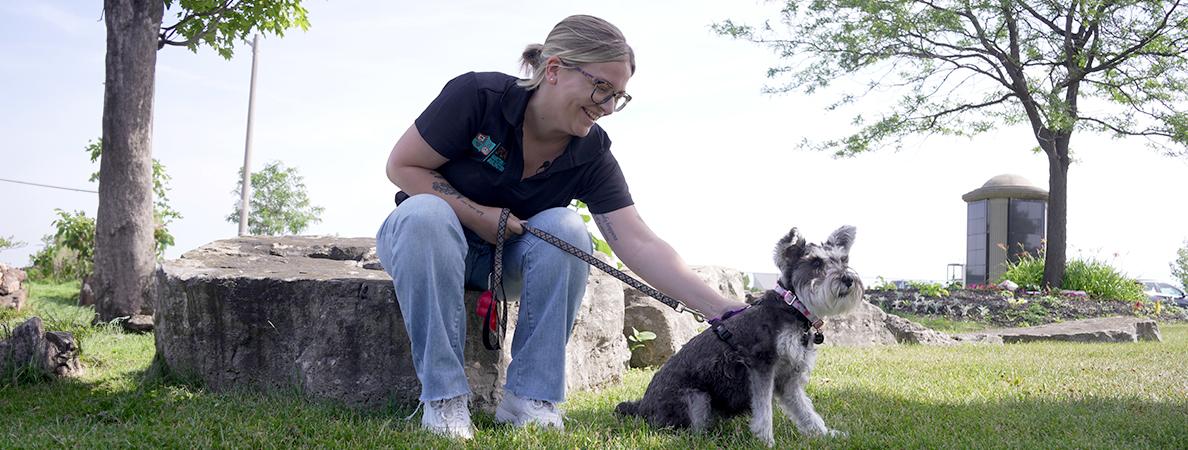
Heading back to school as a mature student was initially challenging for Natalie, a graduate (2024) of the Social Service Worker – 215 program. Natalie had been in and out of postsecondary a few times and thought it might be too late to return to school.
She knew in her heart that she wanted to get into social work, to be in a role that allowed her to help others.
“Taking that leap of faith to go back into a program, even if you have done it a few times, that is something that was a huge challenge for me,” Natalie said. “I'm really proud of myself for just overcoming and taking that leap.”
Finding support at Mohawk College
Being born and raised in Hamilton (and recently moving back), staying in the city was important to Natalie. Mohawk College was easy and accessible to her.
Mohawk also provided student support and wellness services that Natalie was able to utilize.
“The Counselling Services on-site [were] really helpful, and just having access to those kinds of things, supporting me through some stuff going on in my personal life gave me the ability to really succeed on campus.”
Additionally, Natalie shared that one of the most meaningful aspects of her program was the strong connection she built with her professors. Their active involvement in the field broadened her understanding of the many career paths available in social service work.
Learning through real-world experience
Placements throughout her program gave her the chance to explore different areas of social work. Her first placement was at an emergency women’s shelter in downtown Hamilton, where she gained invaluable insight into the challenges faced by vulnerable women in the community—and discovered a lot about herself in the process.
Innovating social work at the SPCA
For her second placement, Natalie learned about an opportunity at the Hamilton/Burlington SPCA through a classmate. Intrigued by the unique role animals can play in social work and community well-being, she pursued a placement there, where she helped develop a new program for the City of Hamilton.
“It's a hybrid fostering program that is urgent care,” Natalie explained. “It supports marginalized community members who are facing unprecedented times of stress and crisis, and we would ultimately be able to support their animal for a fixed period of time and then have them reunite at the end of that.”
The idea for this program first came to Natalie during her placement at the women’s shelter, when she noticed women arriving with their animals. Since the shelter wasn’t able to accommodate pets, it sparked an idea in Natalie’s mind.
Turning a placement into a career: A unique role
Natalie noted that putting this program together is likely what got her a full-time role. Once her placement came to an end, the SPCA wanted to keep Natalie and found a place for her in the organization as the Foster Services Coordinator in the Foster Department.
“I am responsible [along with my boss, who runs the adoptions,] for getting animals out of the building,” Natalie explained. “What that looks like is ultimately [supporting] animals that come into our care through the building that seem eligible and in good shape, to be able to go out into the community. In doing so, it creates more space in our kennels as well, [and allows us] to be able to support new intakes that come to the door. I would say, rescues in the GTA and even further, are in crisis right now and constantly over capacity as well, so the foster program is integral for creating more space that isn't in the kennels itself, to be able to support more animals in the community.”
Supporting people and pets
A typical day in Natalie’s life can look different. Sometimes there is paperwork, recruiting new volunteers, overseeing preventative medical appointments, etc., but regardless of what task she’s doing, Natalie likes working to support animals and the people who love them.
Many people experiencing homelessness in Canada don't enter shelters specifically due to their pets not being allowed. Natalie’s training as a Social Service Worker opened her eyes to this heartbreaking choice many people face: safe shelter for themselves or keep their pet. Programs like the one developed at the SPCA not only help our community members stay safe, but they also make sure these animals are protected.
“I believe that the work that the SPCA does is important for our community,” Natalie said. “Because while human welfare is also very important. Animals don't have a voice for themselves, so they need people to actively advocate for them in the community.”
Lessons learned and looking ahead
Natalie’s Mohawk College experience allowed her to see the value in leaning into things you’re drawn to, even if it’s something completely new.
“Taking that leap and stepping out of your comfort zone is super important,” Natalie said. “I found that the moments where I experienced the most personal and professional growth during my time at Mohawk were moments that I kind of had that instinctual fear or discomfort. And I'm so glad that I pushed past those moments.”
Written July 9, 2024