

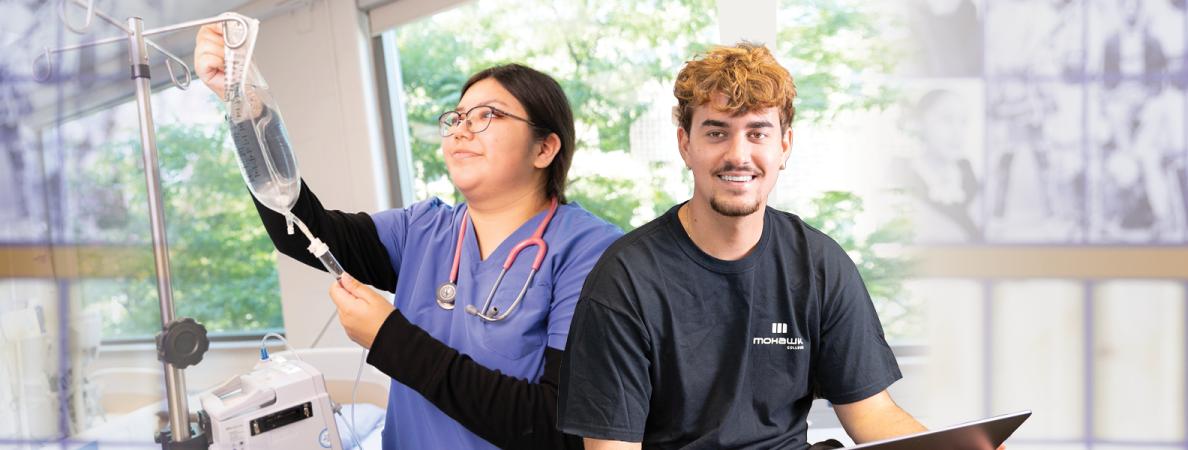
College is more than just lectures and labs; it’s about overcoming challenges, embracing opportunities and personal growth. For students Brooke and Ethan, Indigenous Student Services (ISS) helped transform obstacles into successes. They’re far from alone. Across Mohawk College, Indigenous students turn to ISS for the support to thrive academically, personally and culturally.
“It’s okay to be nervous,” says Brooke, a Practical Nursing student. “I was definitely nervous. But do not let nervousness or anxiety stop you because it does get better. You’re going to find your people. You’re going to find your place. At ISS, I definitely gained a family away from home.”
Turning challenges into growth
Finding your place doesn’t mean the journey will be without bumps. Ethan, who is taking Protection, Security, and Investigation, says the key to starting college is staying on top of things. ISS peer tutors, who support Indigenous students academically, kept Ethan on course.
Whenever possible, ISS provides tutoring by pairing students with an Indigenous peer in the subject they’re struggling with.
“The peer tutors at ISS can be a very valuable resource,” Ethan says. “They helped me get my papers organized in my binders when I started. You can even get help with exams, so ISS is a great place.”
Assistance for Indigenous learners is also built into all of the college’s student support services. If an Indigenous tutor is unavailable for a specific course, ISS refers students to the Mohawk College Learning Support Centre to ensure they still receive the necessary help.
That’s what happened when Brooke needed support with math. She connected with the college’s peer tutoring services. Brooke recommends asking for guidance early if you notice any challenges.
“Peer tutors are great because they’re students in your program, so they understand your stress,” Brooke says. “It made a big difference for me. In general, when you have people in your program to connect with, it makes it so much better.”
From classroom to career
The lessons for Brooke and Ethan went past study strategies. At Mohawk College, Indigenous perspectives are increasingly integrated into the curriculum, providing students with the opportunity to explore how Indigenous knowledge informs their fields. In Practical Nursing, for example, an Indigenous Ways of Knowing course connected Brooke’s coursework to the communities she hopes to serve.
“We learned about the history of how Indigenous people have been treated as well as Indigenous peoples’ cultures and diversity,” says Brooke, who envisions a career that will allow her to travel between First Nations communities to provide care. “The course made me more hopeful that my classmates will understand the experiences Indigenous people have with healthcare.”
Meanwhile, Ethan aims to work for border services or as a police officer. He says ensuring law enforcement spaces are inclusive is essential, and representation plays a key role in cultivating trust with the communities they serve.
“At the end of Grade 12, I did a co-op at a mechanic shop, but I realized I wanted a career where I could help the community,” he says. “I know seeing an Indigenous person working in a place like border services would make other Indigenous people feel more comfortable and relaxed.”
From Brooke’s journey in nursing to Ethan’s path toward law enforcement and beyond, Mohawk College and ISS are preparing Indigenous students to build futures that empower both themselves and their communities.