

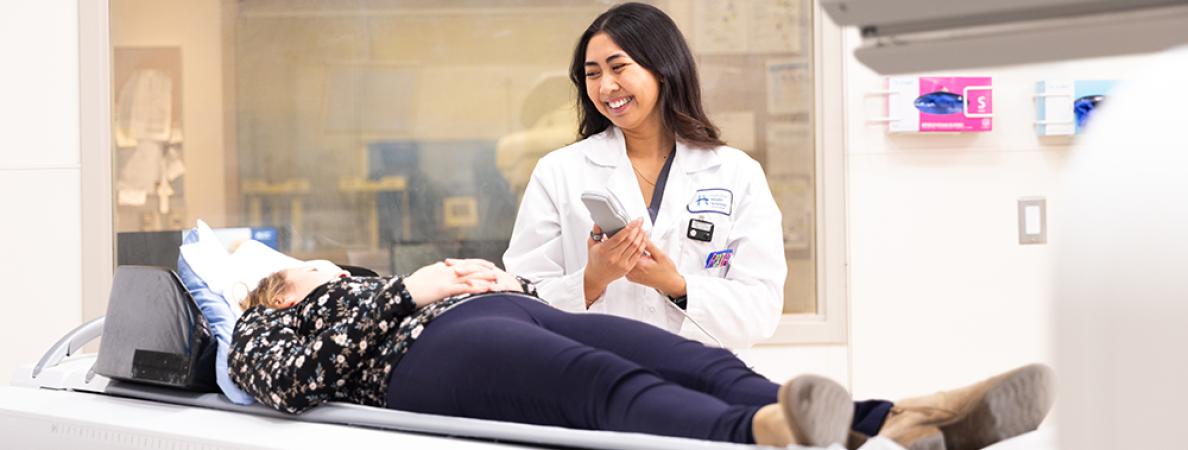
Nuclear medicine is at the forefront of the push towards personalized medicine and non-invasive procedures in healthcare. New advancements in nuclear medicine have changed the lives of patients across Canada as they can now receive faster and more accurate diagnoses through functional imaging, as well as more effective forms of treatment through theranostics, which is a type of radiation therapy.
Students in Mohawk College’s Nuclear Medicine and Molecular Imaging Technology Advanced Diploma program are set to become the next generation of healthcare professionals in this exciting field of medicine.
We sat down with professors, nuclear medicine technologists and experts in nuclear medicine and asked them to demystify nuclear medicine to help you learn more about this exciting field and decide if the Nuclear Medicine and Molecular Imaging Technology Advanced Diploma program is right for you.
Understanding nuclear medicine
Nuclear medicine is a medical procedure where doses of a radioactive substance are used to help diagnosis or treat diseases. To get a more thorough understanding of nuclear medicine, it’s important to learn how it works.
“In nuclear medicine, we use a small amount of radiation, what we usually call radiopharmaceuticals,” says Dr. Olfat Kamel Hasan, nuclear medicine physician at Hamilton Health Sciences and assistant professor at McMaster University.
Radiopharmaceuticals, also known as radiotracers, are administered to the patient through injection, inhalation or oral medication.
“The radiopharmaceutical is actually composed of two components,” Dr. Hasan explains. “The radionuclide, which is the radioactive material that emits radiation and the pharmaceutical which transports the radionuclide to the desired area of the body.”
The chemical makeup of a radiopharmaceutical will depend on what organ is being targeted for imaging or treatment. Every organ in the human body processes different elements, minerals and chemicals. The chemical makeup of a radiopharmaceutical will reflect that, such as phosphorus being used in radiopharmaceuticals that target the skeleton.
“So, you take those base chemicals, and you attach radioactive tracer to them,” says Chantal Saab, a nuclear medicine technologist with Hamilton Health Sciences. “That’s how you can actually trick the body into bringing those radioisotopes into the organs.”
Once administered, the radiopharmaceuticals are then processed by the body. In the case of imaging, the radiation emitted by the radioisotope can be detected by imaging technologies such as a gamma camera or a PET (positron emission tomography) scanner.
Uses of nuclear medicine
The horizon of what nuclear medicine can do is continuing to expand as more research and development is being done. Currently, there are two main ways that nuclear medicine is used.
Imaging
Imaging is the most common use for nuclear medicine. This application falls under the umbrella of diagnostic imaging similar to other methods such as X-rays, CT (computed tomography), MRI (magnetic resonance imaging) and US (ultrasound) all of which provide healthcare specialists with different types of information.
“These [radio] tracers can target different organs in the body and allow us to actually see how everything is functioning,” Chantal explains. “So rather than looking at structures like you would with a CT [scan], MRI or ultrasound, you’re looking at the functionality of the organs, how they are actually working.”
With functional imaging, physicians and other healthcare professionals are better able to diagnose diseases and ensure that their patients are receiving proper treatment.
“Physiologic process changes before the anatomy,” Dr. Hassen says. “So, in any disease, the function will be affected before the changes in structure. That’s why functional imaging is usually detecting diseases earlier than anatomic imaging.”
Along with helping to provide the initial diagnosis, functional imaging also gives medical professionals a more thorough look at how patients are responding to treatment and if they are cured or in remission.
Treatment
Nuclear medicine is also used as a form of radiation therapy for the treatment of certain diseases. Most commonly, radiation therapy is used to treat cancer, but it can also be used to treat other diseases such as hyperthyroidism.
“Think of it [radiation therapy] as targeted chemotherapy,” Chantal explains. “Rather than using a chemotherapy drug to target and treat cancers, we’re using radiotracers that deliver a dose of radioactivity directly to the tumor cell to kill it.”
Radiation therapy is often used in combination with other cancer treatments such as chemotherapy and surgery. New treatment methods for cancer and other diseases are continuously being developed, giving patients more treatment options and potentially reducing side effects.
“Cancer therapy can sometimes cause side effects to the patient, but our [radiation] therapy has much fewer side effects to them because we are targeting a certain physiologic process,” Dr. Hassen says.
The future of nuclear medicine
Medical researchers are always developing new applications for nuclear medicine. This continued effort to develop nuclear medicine has made life better for patients undergoing assessment and treatment for numerous kinds of conditions and diseases.
With the field constantly expanding due to continued research, a career in nuclear medicine is dynamic and exciting. Nuclear medicine technologists play a massive role in the application of nuclear medicine, with jobs being both in-demand and full of opportunities to learn new things and grow your skills.
If you’re interested in learning more about a career in nuclear medicine, read our blog on how to become a nuclear medicine technologist. For more information about nuclear medicine at Mohawk College, visit the Nuclear Medicine and Molecular Imaging Technology Advanced Diploma program page.
Published October 24, 2025