

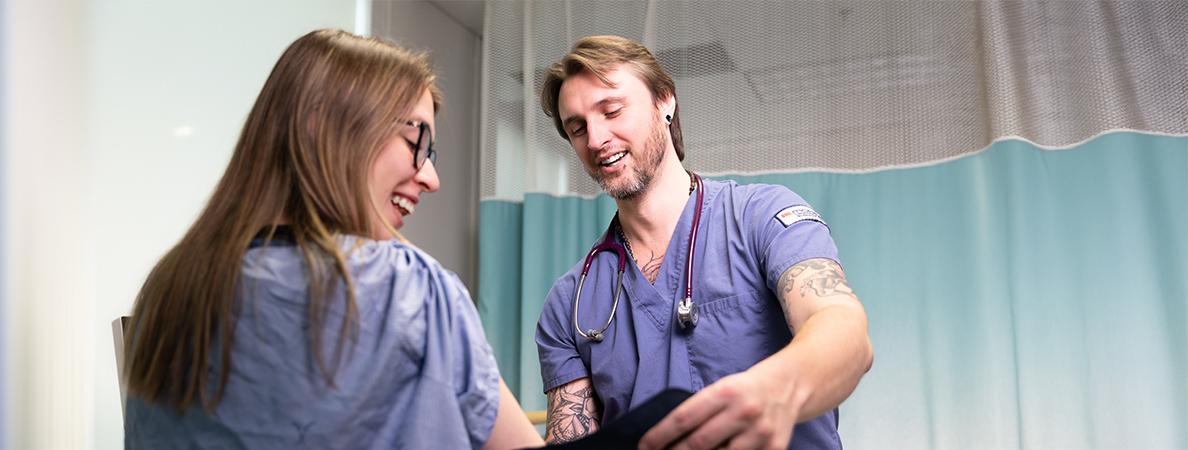
Math always came easily to Scott. So when he earned a bachelor’s degree in physics and math, imagining himself on the teaching side of the desk felt like the obvious next step.
But a few years after graduation, Scott arrived at a crossroad. He wanted a career that aligned with his strengths, and allowed him to connect with people in a way that felt more immediate.
At the same time, heart health was a personal concern. Scott lives with arrhythmias, and several family members have faced cardiovascular issues. Helping to care for palliative relatives pushed him to think more deeply about the science behind the heart, why problems develop and how technology helps diagnose them.
Those experiences, paired with the desire for a new direction, led Scott to Mohawk College’s Cardiovascular Technology (728) program. It was an enterprising move toward a career with impact.
“Being able to identify with who you are interacting with in a personal way and establish a connection not only makes the whole experience easier for everyone involved, but I really do think that it gives you an aspect to care that you can’t just learn,” Scott says of the perspective his own health journey brings to his future career.
Empathy meets industry-led learning
Empathy gives Scott a strong foundation. The technical skills he needs to support patients, meanwhile, are being developed through Mohawk College’s Cardiovascular Technology program. This two-year program trains students to assist physicians in critical areas of cardiac diagnosis, including electrocardiography, Holter monitoring, exercise stress testing and pacemaker or cardiac device follow-up.
“I feel like I am getting a chance to grow not only my understanding, but my own persona into who I want to become,” says Scott. “Someone who is responsible, but able to still connect with people, who gets to seek out new opportunities and learn some very interesting new information, and also apply it. And I think it’s making me a better worker.”
Experiential and industry-led learning are the cornerstones of the Cardiovascular Technology program. With practice opportunities in the program’s dedicated lab, which mirrors a real-world environment (video), students have the advantage of a hands-on clinical placement. For Scott, who completed his first clinical experience at a Mississauga clinic, it wasn’t just a chance to apply what he’d learned in class; it was a glimpse into how meaningful this work can be.
“The crowning achievement, I think, of any healthcare professional is that your patient liked what difference you were able to make, not just outcomes-based, but in the way that you did it, and that’s huge,” he says.
Not just a number
Experiences like clinical placement have reinforced Scott’s confidence that he is on the right path. But he says the program’s real strength lies in its faculty. He credits instructors and professors for helping him build confidence. That commitment to student success, Scott says, shows up both in class and in the one-on-one conversations that make learning feel personal.
“What I enjoy the most about my instructors is that they don’t end with just the materials on the slides or what they’re talking about in the PowerPoint,” he says. “They’re willing to go above and beyond to answer queries and impact personal experiences … Having that professional discourse, in addition to having the connection to all the experience they have had in the field, is just invaluable.”
Scott came to Mohawk College looking for a new direction. What he found was a community ready to help him grow and guide him toward success. He believes that with an interest, a connection or a spark—and the enterprising mindset to follow it—anyone can build a meaningful career.
Published January 7, 2026