

Labs and Simulation Spaces
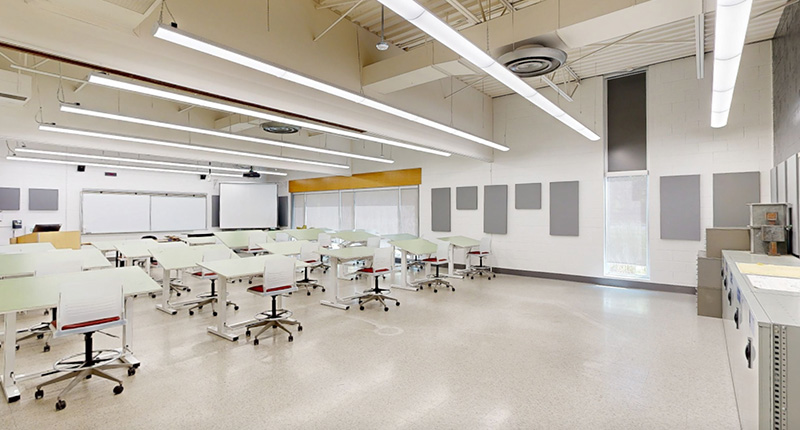
Drafting Lab
In the Drafting Lab, students develop the skills needed to read, create and interpret technical drawings used in the skilled trades. Working with industry-standard software and drafting tools, learners practice producing precise plans, layouts and schematics that reflect real construction and manufacturing requirements. The lab provides a hands-on environment where students refine their accuracy, attention to detail and understanding of design standards essential for success in trades and technical fields.
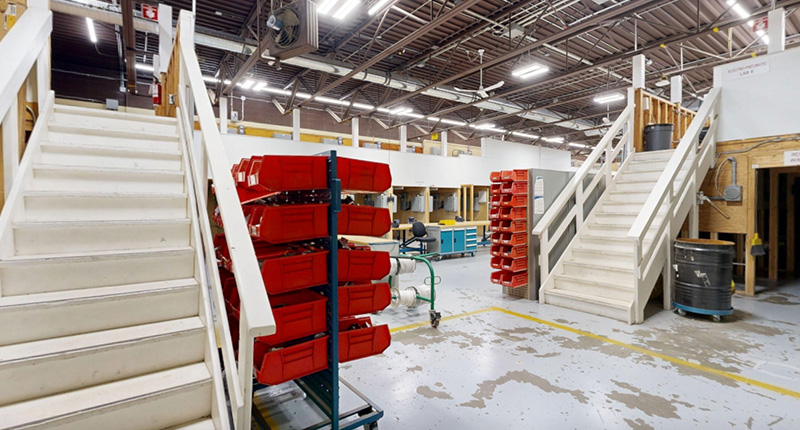
Electrical Lab
In this lab students complete projects that simulate typical work in residential, commercial or industrial settings. Students work on everything from wiring installations in a dwelling unit to motor control in a commercial setting to programming AC and DC drives that would be typical in industry.
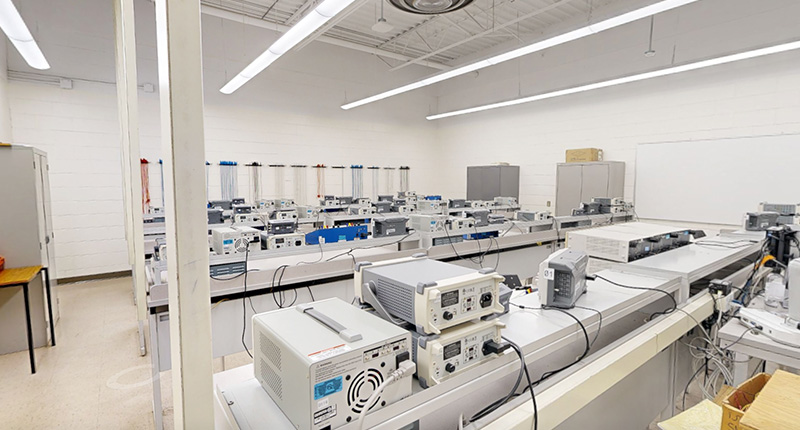
Electronics Lab 1 (Stoney Creek)
Electronic circuits and devices play a vital role in our modern society and our reliance on electronics will continue to increase. In this lab students explore the fundamentals of electronic circuits and devices by designing, building and testing industry-standard circuitry. This hands-on experience equips students with the essential skills needed to thrive in an increasingly electronic-driven world.
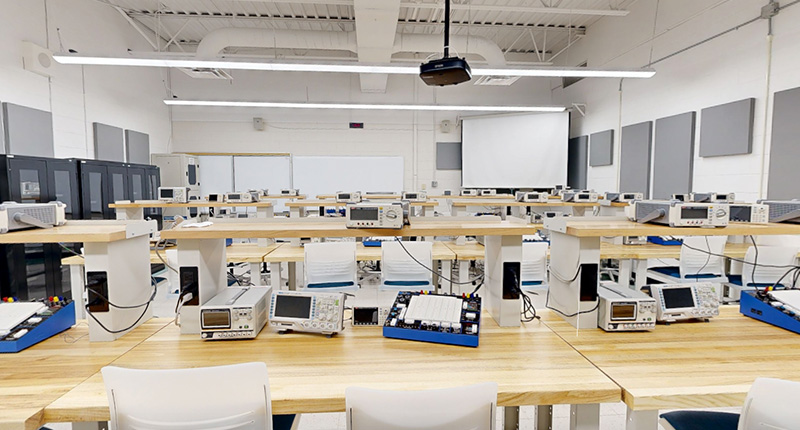
Electronics Lab 2 (Stoney Creek)
In the Electronics Lab, students learn how to diagnose, test and repair the electrical and electronic systems found in today’s vehicles. Using industry-standard diagnostic tools, wiring schematics and component test benches, learners practice everything from basic circuitry and soldering techniques to advanced troubleshooting of sensors, control modules and multiplexed systems. The lab provides a hands-on environment where students build the foundational skills needed to confidently service modern automotive electronics.
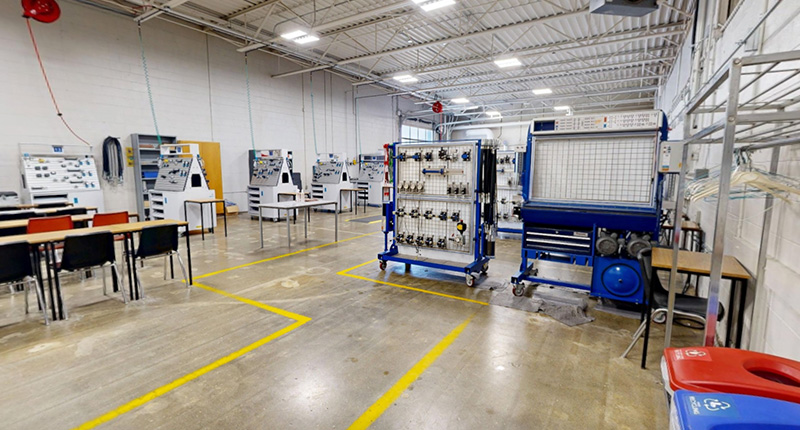
Hydraulics Lab
This lab introduces the principles of industrial hydraulics, including the design and application of power units, pumps, motors, conductors and fluids. Utilizing fluid power equipment, our students have the opportunity to do lab experiments with typical valving and accessories found in industry today. With a variety of applications, hydraulic systems are used in all kinds of large and small industrial settings, as well as buildings, construction equipment, and vehicles.
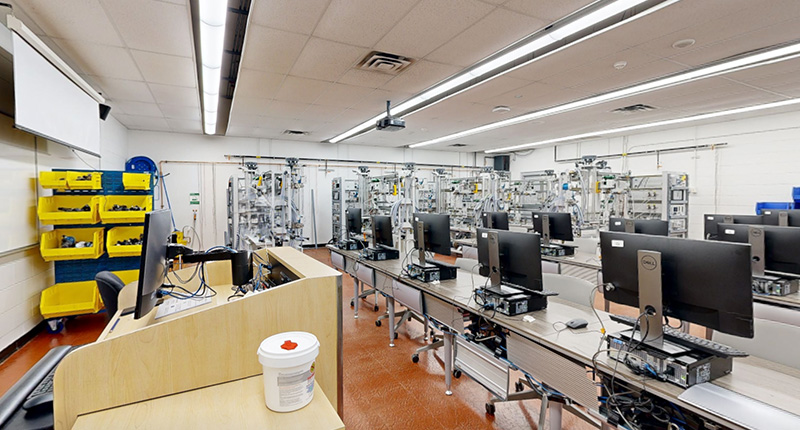
Instrumentation & Control Lab
In the Instrumentation and Control Lab students are taught how to install, maintain, calibrate, design and troubleshoot networking systems, process control equipment and environmental protection systems for a wide range of industrial applications.
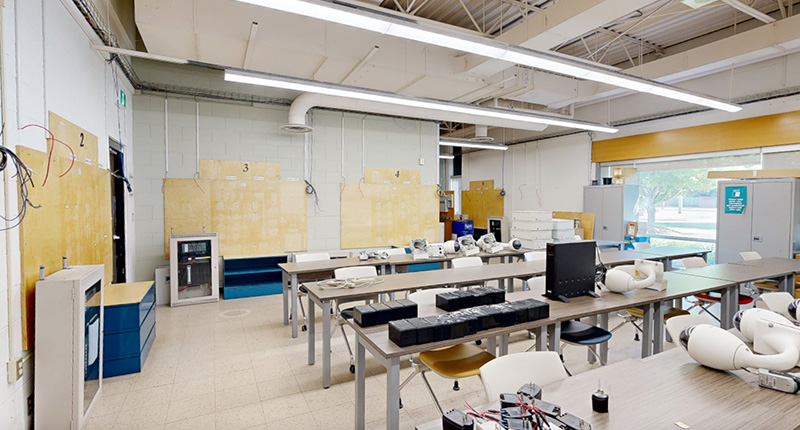
Monitoring & Communications Lab
In the Monitoring and Communications Lab students receive training on the installation and maintenance of various systems, including fire alarm systems, emergency nurse call equipment, access control, industrial and residential security systems, as well as home automation technologies. This hands-on education prepares students to meet the diverse needs of modern electrical systems and enhances their expertise in ensuring safety and efficiency in various environments.
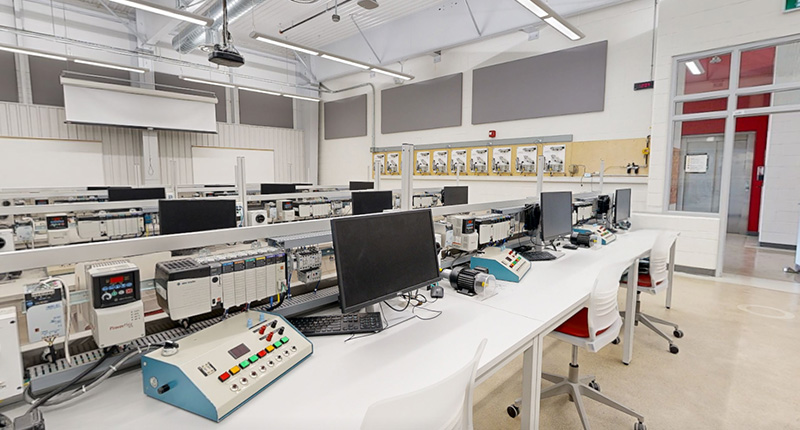
PCL Lab
In a manufacturing plant, the effective control of devices, motors and processes is essential for ensuring the continuous movement of materials and the production of high-quality products. Our students gain hands-on experience with motor controls utilizing programmable logic controllers (PLCs), and focus on the collection, management, display and application of machine data. This training is crucial for developing the skills needed to optimize manufacturing operations and improve overall efficiency.
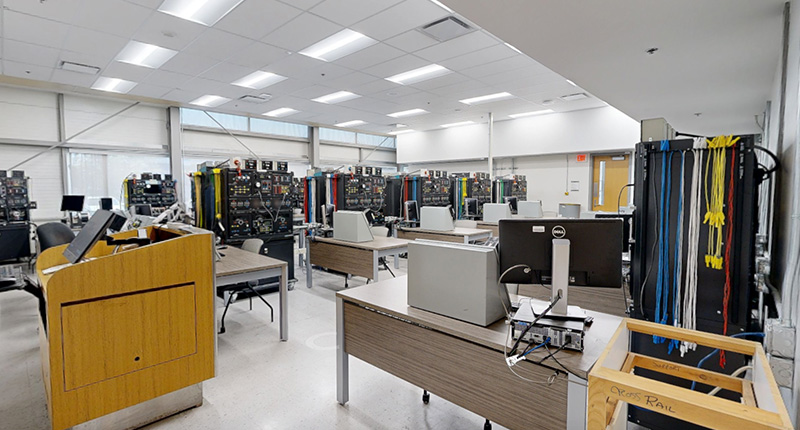
Rotating Machines and Power Systems Lab
In the Rotating Machines and Power Systems Lab students engage in connection and analysis of AC and DC generating systems, as well as motors and motor control systems. They work with single and three-phase transformers, exploring the behaviour of inductive, capacitive and resistive loads. Additionally, students analyze and address power quality issues, gaining hands-on experience in diagnosing and correcting inefficiencies within electrical systems.
Learn more about the Rotating Machines and Power Systems Lab
