

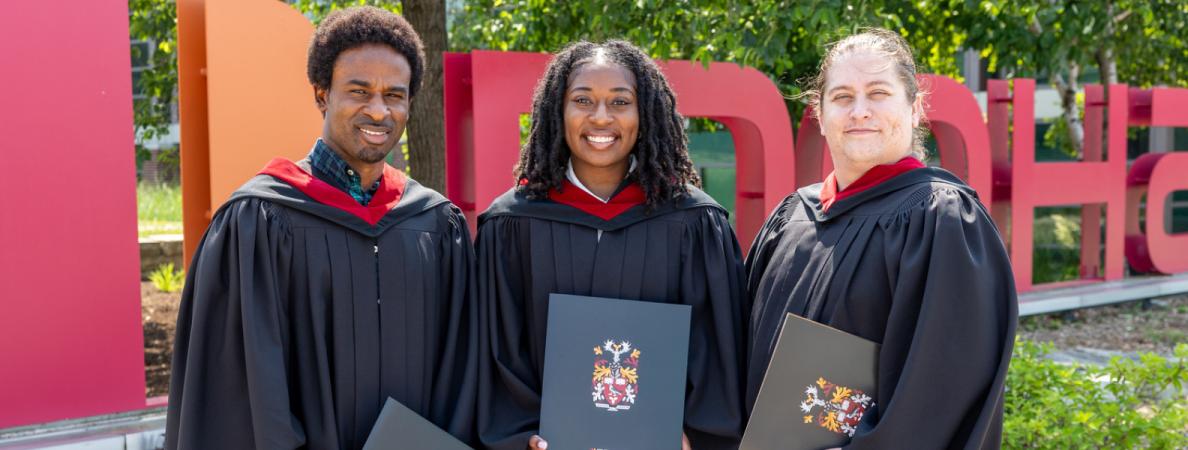
Seretta and Zachary took very different paths to Mohawk College. Seretta came straight from high school, recruited to the school’s varsity basketball team and ready to earn a degree. Zachary spent two years at university and nearly a decade in the workforce before returning to college to expand his skill set through hands-on degree learning.
Their journeys may have looked nothing alike, but both saw the value of a bachelor’s degree that goes beyond theory.
They’re not alone in that realization. Across Canada, more than half of businesses say workers aren’t fully prepared for the job. The biggest gap? Technical, practical and job-specific skills—the kind that help graduates jump in and contribute from day one.
That’s exactly what Mohawk College’s applied degrees are all about. The three- and four-year bachelor’s programs blend classroom learning with real-world experience, helping students hit the ground running.
“There’s definitely nothing like an applied degree,” says Seretta, who was hired immediately after her final exams. “It’s so unique, valuable and the best of both worlds. You get the hands-on college experience, and you’re earning a degree.”
How applied degrees put learning into action
Mohawk College’s applied degrees are developed with local employers to ensure students are ready to meet the demands of the future of work. The college currently offers 10 applied degrees across business, climate action, technology and healthcare:
Business
Sustainability & Climate Action
- Bachelor of Management – Sustainability
- Bachelor of Management - Sustainability (Honours)
- Bachelor of Technology – Sustainability
- Bachelor of Technology - Sustainability (Honours)
Technology
- Bachelor of Technology Partnership: Combined Degree/Diploma
- Bachelor of Technology Partnership: Degree Completion
Health
While the subjects differ, the programs share the same philosophy of balancing theory and practice. Students learn in classrooms and labs, take part in simulations and gain real-world experience through field placements or work terms. By the time they graduate, learners already have experience applying their knowledge in real settings.
For Zachary, the embedded practical application stood out immediately. During his program, he completed a capstone project and a work placement, experiences that closely mirrored real work scenarios and environments.
“That [work placement] experience gave me a taste of what an employment opportunity after graduation could look like,” he says.
Seretta, meanwhile, completed three work placements and a capstone during her four years at the college. She says engaging directly with industry allowed her to explore career options and discover why Mohawk College’s grads have a 100 per cent employer satisfaction rate.
“I can attest to that amazing statistic,” she says. “Our capstone clients, for example, were definitely satisfied. The capstone is a year-long project, and it just brought so much confidence knowing that what I learned in the classroom applies to real life.”
Benefits that go beyond curriculum
Mohawk College’s approach to education doesn’t just deliver strong academic experiences; it produces meaningful outcomes. Across Ontario, 85.8 per cent of college graduates found work within six months of finishing their program in 2022–2023, and 76 per cent landed jobs directly in their field.
At the college, that kind of success comes from more than classroom lessons alone.
Small class sizes, for example, mean professors know students by name and support their goals. Faculty also bring real industry experience, connecting what students learn to what employers need.
“The professional connections I made with teachers and the opportunities they gave me, those were probably the most important things to me (in choosing an applied degree),” says Zachary.
Seretta agrees, “At Mohawk College, I wasn’t just a number,” she says. “I believe if I went anywhere else, I wouldn’t have gained the confidence I have. It’s because of the professors who really believed in me and my classmates and encouraged us.”
Their paths to Mohawk College were entirely different, but both Seretta and Zachary left with applied degrees that don’t just check a box in theory. Instead, they develop the skills and confidence to turn learning into real results.
Published November 17, 2025