Academic Appeals

Mohawk College is committed to fairness and consistency in making decisions affecting students. The Academic Appeal process is a service function for students that provides a mechanism for reasonable review of grading decisions affecting their academic progress.

Scope: 

  • Includes: Appeals of final course grades, academic integrity breaches, probation/withdrawal decisions, and Prior Learning Assessment & Recognition (PLAR) outcomes. 

  • Excludes: Workplace/clinical placement removals, failed co-op terms, discrimination/harassment or sexual violence complaints (handled via separate policies).  

All policy details and official forms can be found on the Student Policies and Procedures webpage.
 

Grounds for Appeal 

Students must base an appeal on one of these evidence-based grounds. Disagreement with a final course grade alone isn’t enough—you need documented proof that something went wrong.  

Tip: Without proper evidence, an academic appeal is likely to be dismissed as “insufficiently supported” and denied to move forward in the process. Gather your documentation before you start filing your Step 1 academic appeal. 


Burden of Proof 
Students must show that the original decision was wrong and deserves to be changed. 
 

Academic Appeals & Timelines 

Step 1 – Academic Review 

Informal Attempt: Connect with Your Instructor First 

1. Before you begin a formal Step 1 appeal, you're encouraged to reach out directly to your instructor to discuss your concern. Most academic issues, especially misunderstandings about grades, missed expectations, or feedback on assignments, can be resolved quickly through a respectful conversation. 

Your instructors want you to succeed, and they can often provide additional context, clarify grading decisions, or explain course expectations that may help resolve the issue without needing to escalate further. Starting with a collaborative approach helps maintain positive relationships and keeps the focus on learning and growth. 

If you’re unsure how to start the conversation, consider asking for a brief meeting or sending a polite email outlining your question or concern. If the issue can’t be resolved or you feel that a mistake or policy violation has occurred, you still have the right to proceed with a formal Step 1 appeal. 

Tip: Keep a written record of your informal efforts—email exchanges, meeting notes, or a log of your communication—as this is a requirement of the formal Step 1 appeal process. 


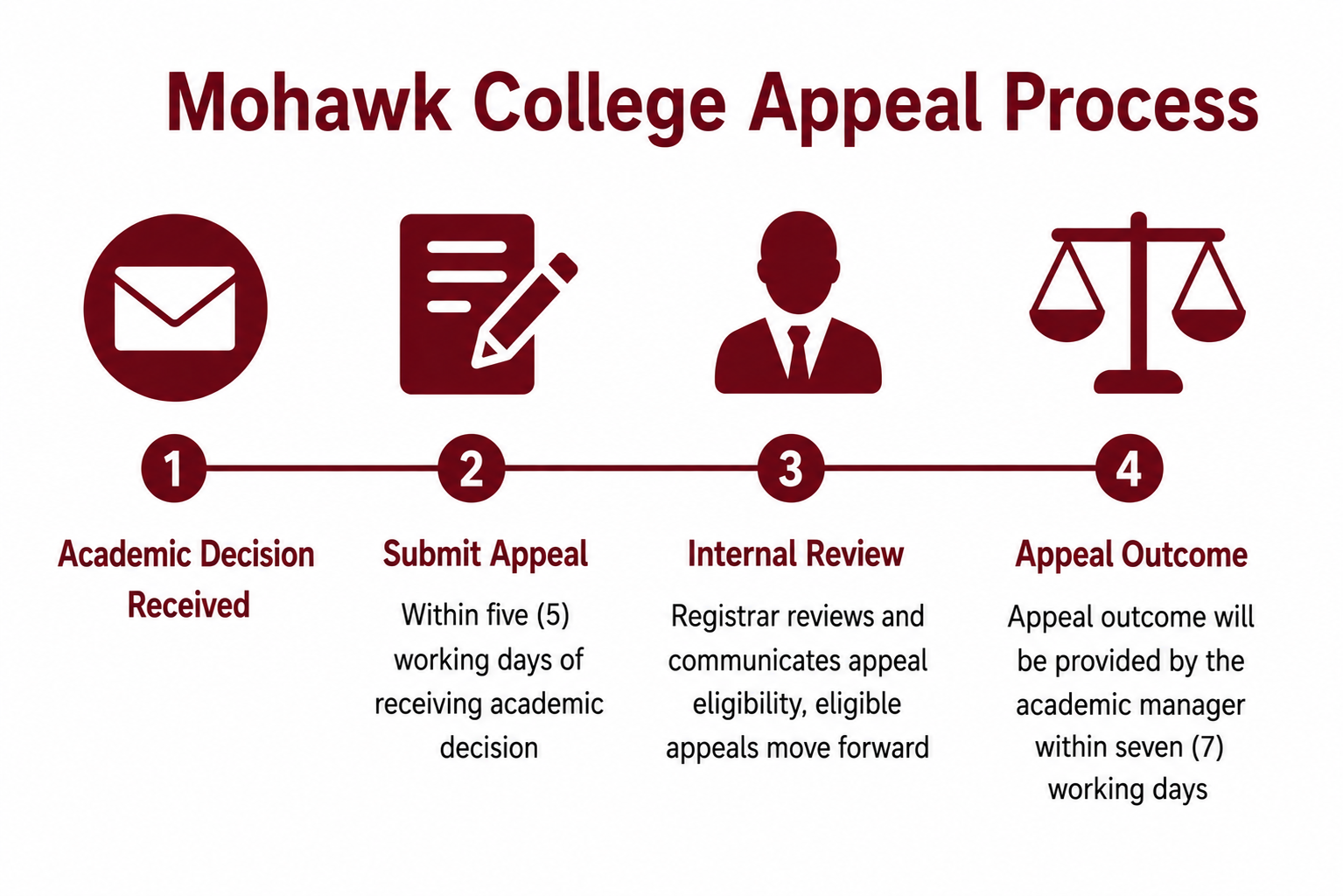
  1. File Step 1 Appeal: If not resolved through informal attempts, submit the online Step 1 Appeal Form within 5 working days of the academic decision date.  
     
    Be sure to include: 

  • Grounds for appeal 

  • Supporting documentation 

  • Summary of your informal discussion 
     

  1. Review: Registrar’s Office reviews and validates the Step 1 appeal, then forwards approved appeals to the Associate Dean to review and provide a decision and appeal outcome.  

  1. Decision: Associate Dean issues a written decision within 7 working days of receiving your Step 1 appeal file. Possible outcomes include: academic decision upheld, academic decision modified, academic decision is revoked, or the original academic decision is adjusted. 


Interim Course Participation 

You may continue attending and submitting work in your courses during the Step 1 appeal process, except for placements and practicum that are integrally tied to your program.  


Confidentiality and No Retaliation 

All academic appeals are confidential. No one may retaliate against you for filing an appeal. However, if an appeal is found to be false or malicious, disciplinary action may follow. 

Roles & Responsibilities  

  • You (Student): Gather evidence, meet deadlines, and engage in informal resolution first. 

  • Instructor: Respond in good faith to informal and formal steps. 

  • Associate Dean: Review Step 1 appeals and issue timely decisions and outcomes to the Student. 

  • Registrar’s Office: Administer and process appeal requests, screen Step 1 appeal requests, coordinate approved Step 2 appeal hearings, and keep records. 

  • Academic Appeals Committee: Conduct fair hearings for approved Step 2 academic appeals and issue binding decisions.  
     

FAQ: Understanding Your Grounds for Appeal


What does “Accommodation” mean as a ground for appeal?  

This refers to a situation where you had a registered accommodation through Accessible Learning Services, such as extended time or note-taking supports, and it was not properly implemented, which affected your academic performance.   

  • Valid Example: You were approved for a distraction-reduced test setting but were placed in a noisy classroom.     

  • Not Valid Example: You never applied for accommodations or you failed to follow up to ensure they were activated.     

  • Helpful Documentation: Your approved accommodation plan, along with correspondence or notes demonstrating how it wasn't implemented.  

What counts as “Course Management”?  

This relates to how your course was administered compared to the course outline. Grounds include changes to essential items like test schedules or grading schemes that weren't communicated fairly.   

  • Valid Example: The course outline stated the final exam was 40% of your grade, but it was graded as 60%.     

  • Not Valid Example: You felt the instructor’s teaching style wasn't effective.     

  • Helpful Documentation: The course outline and any emails or screenshots showing unexpected changes.  

What are “Extenuating Circumstances”?  

These are severe, unanticipated events beyond your control-like a serious illness, death in the family, or a house fire-that directly impacted your ability to complete a specific element of the course. Mohawk’s policy requires a direct connection to a specific course element, and a request to pass the entire course based solely on such circumstances will not be accepted by Mohawk College.    

You can still appeal without formal documentation, but you should provide as many details as possible (e.g., dates, impact, and who can verify) to help us understand your situation.   

  • Valid Example: You were hospitalized the week of a major exam and were unable to write the exam as a result.     

  • Not Valid Example: You simply forgot about the assignment deadline.   
      

  • Helpful Documentation (if available):  

  • Official notes (e.g., doctor’s note confirming your inability to participate, we do NOT require diagnosis details)  

  • Obituary or funeral notice  

  • Police report or insurance claim  

  • Or a detailed personal statement-including dates and any secondary confirmation, such as emails from family, roommate communication, or counsellor notes.  

Can illness or disability be grounds for appeal?  

Yes, if the illness or disability directly impacted your academic performance and you couldn’t meet requirements even with accommodations.   

  • Valid Example: You had a sudden mental health crisis during final exams or during the mid-term and were unable to complete your work.     

  • Not a Valid Example. You felt unwell but didn’t consult a medical professional or notify your Instructor about it.     

  • Helpful Documentation: A note or letter from an Allied Health Professional or confirmation from Accessible Learning Services - even if it doesn’t specify a diagnosis.  

What about discrimination claims?  

If your appeal involves discrimination or harassment, note that Mohawk College’s Academic Appeal process is not the exclusive avenue for these issues, as such concerns may be addressed through the Student Rights Office.  

Your appeal under “Bias or Unfair Treatment” can proceed through the Academic Appeal process, but discrimination-related claims may and should be managed in parallel through the Student Rights and Responsibilities Office to ensure proper handling and resolution.  

What is a “Merit of Work” appeal? 

Used when you believe your work was graded improperly based on objective evidence-such as ignored grading criteria or calculation mistakes.   

  • Valid Example: Your assignment was penalized for components not covered in the rubric.     

  • Not Valid Example: You simply wanted a higher grade or another chance to pass the course.     

  • Helpful Documentation: The rubric, your graded submission, and a side-by-side comparison showing how your work met the expectations.  

What constitutes “Personal Bias or Unfair Treatment”?  

This ground refers to being treated differently from other students in a way that affected your academic outcome.   

  • Valid Example: You were penalized for a late submission while others received extensions for the same situation.     

  • Not Valid Example: You didn't feel supported or didn't connect well with the instructor.     

  • Helpful Documentation: A timeline, emails, or screenshots clearly showing the discrepancy in treatment.  

What is a “Policy Violation” appeal?  

This applies when a Mohawk College policy or academic procedure was not followed during your grading or assessment.   

  • Valid Example: A midterm grade was changed after the term ended, without your knowledge or any explanation.     

  • Not Valid Example: You disagree with the outcome but can’t point to an actual procedural violation.     

  • Helpful Documentation: Provide the relevant policy or official link, and explain how it was misapplied in your case. 


Quick Reference & Links